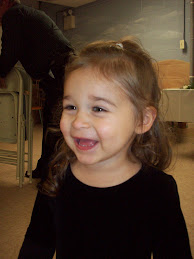
People often say we need to treat the cause of a disease rather than the symptoms, since treating the symptoms without knowing the cause is like putting a band-aid on the problem, not solving it. We need to get to the root of the problem, what is causing the symptoms? Well, this doesn't apply to childhood mental illness. Too young for an official diagnosis, all we can do is treat the symptoms that the child presents and hope that they are effective, and if not, make necessary adjustments along the way until the child is old enough to determine an "accurate" diagnosis.
A few weeks ago, I took Katelyn to see her developmental pediatrician for her routine followup appointment. We have a great system of communication and I regularly update her via email on how Katelyn is doing. I had described some recent concerning events, including what appeared to be mood swings (going from rage/aggression to hysterical laughter), hyperactivity and uncontrollable laughter episodes where she does not seem to be in touch with her surroundings, and some odd signs that we had not seen since starting her current medications roughly a year ago that made us suspect she could possibly be seeing or hearing things that are not really there.
Since she is now so much more verbal than in the past, she is able to articulate her thoughts a bit more clearly, which does sometimes help, but at her young age of just shy of 5 years old, it still leaves us questioning how much is "normal" and how much could be signs of mental illness? For instance, many children have imaginary friends or have great pretend skills. In fact, one of Katelyn and her sister's favorite things to do is pretend they see Swiper the fox from Dora the Explorer and yell, "Swiper, no swiping!" and run away, laughing. However, the difference in my opinion of what is "normal" imaginative play and abnormal behavior is when the child becomes visibly frightened and goes into a complete meltdown, over what could otherwise be perceived as pretend play. I am not a mental health professional, but it doesn't seem normal to me that a child would be terrified by "normal" pretend play or imagination.
Below is a video from April 2011 that shows just one example of what I'm referring to. I will fully admit that I did not know what the proper response would be in this situation, to tell her that what she thinks is a little girl is not real or to pretend that I did see the little girl too. I was not prepared for this and was caught off guard.
At the appointment with her developmental pediatrician, we discussed the symptoms and changes in detail. At that point, the doctor said that she feels that Katelyn may be displaying psychotic features as we have suspected for a while, and that we should slightly increase her atypical antipsychotic medication to see if it helps. She further stated that if this is the case, Katelyn may not be able to distinguish what is reality and what is not, and that we need to provide her with as many positive, happy moments in her life in order to help her discern in the future what is real and what isn't when she is an adult. She will possibly need medication for her whole life to help her with this as well.
The doctor said that she is not ready to diagnose schizophrenia or something similar at this time due to Katelyn's young age, but she does foresee her receiving a mental health diagnosis down the road once a more definitive diagnosis could be reliably achieved, if possible. At this point, PDD-NOS is the closest diagnosis that seems to fit Katelyn's profile, although she demonstrates many atypical signs as well.
The good news is that Katelyn continues to thrive and improve at her new private day school. She could not be happier at her new school and she is responding very well to the ABA approach, which further demonstrates my argument that it doesn't matter what she is diagnosed with -- call it "XYZ" or "ABC" -- if it is working, then it is an appropriate method of treatment!
So, until we get an official, reliable mental health diagnosis for Katelyn, we will continue to treat her symptoms instead of trying to determine the cause, despite how difficult it is to not know what exactly is going on with your child. For now, we'll hold out hope that one day in the not-too-distant future, we will have the answer we are looking for. And whatever that answer is, we will deal with it, and do everything we can to empower Katelyn to deal with it as well.